Video
Unit video
The narrated video for Unit 16, about 9 minutes, is published with the first release.
Learning purpose: An error in a respected published table, the difference between an established fact and a repeated claim, and the course's own mistake with both.
Accessible text alternative: the transcript linked below, and this page, which covers the same material.
Transcript of the Unit 16 video
The narration is spoken by synthetic voices made for this course, each shown on screen as a drawn robot. No person is speaking.
Watch what changes
Required on the complete route, and the unit where this course checks itself. It works through a published error in Note G's table, the course's own mistaken account of that error, and the difference between a claim that is established and one that is merely repeated. The lesson — that a claim's status is part of the claim — is also recorded in Misconceptions and expected errors entry 12, "Published means true"; this unit is where you do it rather than read it.
Reading time: about 13 minutes. Activity: about 12 minutes.
Checkpoint: cp16-note-g.
Before this unit: Unit 6 (the Bernoulli numbers and Ada's indexing) and
Unit 8 (the verification lab).
How to read the citations on this page
This unit is about the difference between a claim you can stand behind and a claim you have merely heard often. It would be absurd to make that argument sloppily, so this page marks its historical claims. A key in square brackets, such as [P2a] or [S7], is an entry in References and source policy. Two further marks are particular to this page:
- (Menabrea 1843) — covered by the primary source: L. F. Menabrea, "Sketch of the Analytical Engine invented by Charles Babbage", translated with Notes A–G by Ada Augusta, Countess of Lovelace, in R. Taylor (ed.), Scientific Memoirs, vol. 3, London, 1843. The full bibliographic entry is [P2] in References and source policy.
- unsourced — this course has not verified it. The label is deliberate: the claim appears here because leaving it out would be misleading, not because it has been checked, and each such claim is recorded as an open question in Historical Notes. It is the same "unsourced" bucket that section 6 of this page defines.
Fuller detail on every historical claim is in Historical Notes; this page does not duplicate it.
1. What the document is
In 1843, an English translation of Menabrea's account of Babbage's Analytical Engine was published in the third volume of Taylor's Scientific Memoirs. The translator was Ada Lovelace, and she appended to the translation a series of her own notes, lettered A to G (Menabrea 1843).
Note G is the last of them. It contains a table that sets out, operation by operation, how the engine would compute a Bernoulli number (Menabrea 1843).
The number worked through is the one Lovelace labels B7. Her scheme numbers only the Bernoulli numbers that are not zero, and with the odd integers, so each of her labels is one less than the modern index: her Bk is the modern B(k+1) (Menabrea 1843):
| Lovelace's label | modern index |
|---|---|
| B1 | B2 |
| B3 | B4 |
| B5 | B6 |
| B7 | B8 |
You met this mapping in Unit 6. The values are tabulated in Historical Notes, deliberately not repeated here, because working the value out for yourself is the checkpoint.
2. The claim this course makes
Note G's published table contains at least one error.
That is stated as established. It is recorded, with its supporting material, in Historical Notes.
Read the sentence again and notice how little it says. It does not say where the error is. It does not say what kind of error it is. It does not say whose it was. Everything that sentence leaves out, it leaves out on purpose, and section 3 shows what it took to earn each of the pieces it leaves out.
3. One claim checked, one still refused
You will encounter a specific account of the error, repeated widely and confidently: that one operation in the table has a divisor and a dividend the wrong way round (the number it divides by and the number being divided). You will also encounter attributions — to Lovelace, to Babbage, to the printer (the compositor who set the type), or to something introduced in translation.
Those are two different claims, and they belong in two different buckets. Which bucket each goes in can change when a check is actually done, and that movement, from "widely repeated" to "checked against the source", is the whole point of the unit.
The description has been checked, and it holds. A facsimile (an exact image)
of the printed diagram was examined (recorded as [P2a] in References and source policy). An error
is in operation 4, which acts on the variables V₅ and V₄ in that order,
while producing its stated result (2n−1)/(2n+1) requires dividing V₄ by V₅.
So the operands are inverted, exactly as the common account says. This claim sits
in established, not contested — not because it is repeated often, but because
the check was actually done, against the source rather than against other accounts.
The copy used is a processed image of the printed plate (straightened and
sharpened; Wikimedia Commons [P2a]): in it the location, the operand order and the
division sign are all legible. An earlier, compressed photograph showed the
operand order but not the sign clearly.
See Historical Notes §4.
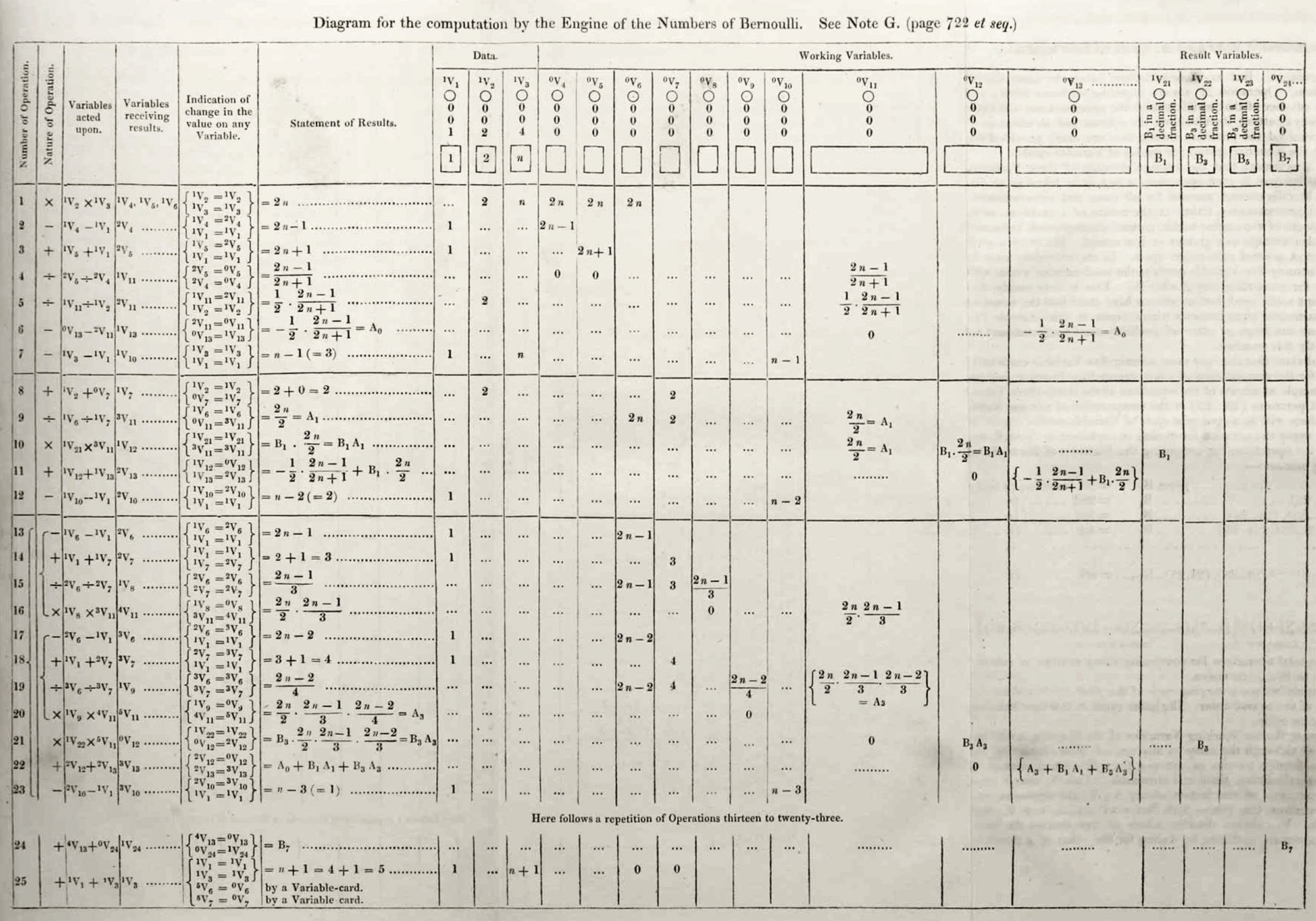
The Note G diagram as printed, 1843 (facsimile [P2a]), the copy read here: a processed image of the printed plate, public domain, via Wikimedia Commons. Operation 4 is the row numbered 4.
The attribution is still refused. Who introduced the slip -- the printer, Lovelace (as author of Note G and translator of the memoir), Babbage -- is not something the table can settle, and the common "it was a typesetting error" is an inference, not a finding. That stays contested. Two related things this course has also not established:
- how long the error stood in print before anyone remarked on it (unsourced)
- who first published a correction (unsourced; both are recorded as open questions in Historical Notes)
Notice the shape of that. The check that was available got done, and one claim moved. The check that is not available — into who set the type in 1843 — has not, and that claim did not move. The honest position tracks what has actually been verified, not what would read well.
A note on the buckets. Contested does not mean "probably false", and it does not mean "nobody knows anything". It means sources disagree, or the claim is widely repeated but its evidential basis is unclear. Claims move out of this bucket when the check that would settle that basis is done. The operand inversion just did; section 6 says what would move the attribution.
4. Why an error like this survives
This is the part that transfers, so it is worth being precise about the mechanism.
An error in a private working notebook gets caught or it does not, and either way it affects one person. The Note G table was in a different position entirely. It was in print. It was in a respected series. It was attached to two names readers had reason to respect. And it concerned a computation that very few readers were ever going to sit down and redo by hand.
Here is the uncomfortable part: each of those properties would plausibly reduce the chance that anyone would check it. That is a mechanism that would explain an error surviving, not a finding: this course has no source on who read the table, how closely, or for how long the error went unremarked (section 3).
If it is what happened, it is not a story about careless readers but about reasonable ones. Attention is finite. Spending it on a source that has already been vouched for, in a venue that has already applied its own scrutiny, is normally the right call, and in a case like this one it would be the wrong one.
An error inside something already trusted does not have to survive careful checking. It only has to arrive where people have already stopped checking.
This is not a nineteenth-century problem that modern tooling has solved, and the clearest example is this course's own. Across the web, the Note G table "as printed" is said to compute −25621/630 [S6]. This course recomputed it, got 139/630, and published that as a refutation. Both figures are reproducible; neither claim was complete.
Note G's table carries more than one printed fault. Operation 4 divides the wrong way round. And on Glaschick's reading [S7, sec. 5.2], operation 24, as printed, leaves out a change of sign that the computation needs. The printed row has been read in the facsimile; treating it as a fault follows Glaschick's reconstruction.
The table also uses earlier Bernoulli numbers, which may be supplied or generated by the routine itself. Those choices give at least four different answers, set out in Historical Notes §4. Supply the earlier values, and you get 139/630, but only having repaired operation 24 without saying so. Let the same routine, operation 24 still repaired, feed its own output back in, and you get −25621/630. Neither the web accounts nor this course had stated which object was being run: which version of the table, under which conditions.
Retrieval can amplify such a figure rather than correct it. One major assistant, as of November 2026, may search the web without being asked [D4, opening note]. A search returns what pages say, so a figure repeated across the web can come back as a cited answer, its repetition looking like corroboration.
So the failure is not that someone repeated a wrong number. It is that a confident, checkable-looking claim was made without saying what it was a claim about — inside finished, internally consistent, already-vouched-for accounts, this course's included. The fix is not more care. It is stating the interpretation, then recomputing under it, and treating a bare number with no stated interpretation as unfinished rather than as evidence.
5. Why this is a unit about verification, and AI is its newest case
Change one variable and hold the rest fixed.
Fluent generated text has the same properties, the ones that protect an error from being checked. It arrives finished rather than in draft. It is internally consistent, so nothing catches the eye. And nothing visible marks where the correct parts end and the wrong parts begin: the tone does not change, the cautious wording does not increase, the sentence structure does not change.
That last property is the one that matters. A statistically plausible continuation can make an unsupported citation as polished as a correct one. Ordinary style and confidence are therefore insufficient evidence. Some systems can expose sources or calibrated uncertainty signals, but those still need to be checked for the task at hand.
The historical analogy is limited but useful: both readers face a polished claim whose appearance does not establish its source. And notice who made Note G's error: whoever introduced it, every candidate is a person, because in 1843 there was nobody else. The problem this course is about is older than AI. Modern generation differs mainly in scale and speed: a plausible table in seconds, a thousand of them in an hour, while checking one still takes the minutes it took then. It also differs in variability, and in the possibility of attached retrieval or tools.
What settled the question here was a certificate in the sense of Unit 8: the facsimile, a source with a locator that anyone can open and read for themselves. A description of the page, however confident, could not have done that.
6. The skill: three buckets
The response is not scepticism. Blanket scepticism is as useless as blanket trust and far more exhausting; a person who doubts everything checks nothing, because they have no way to decide where to spend the effort.
The response is sorting. Put every claim in front of you into one of three buckets.
Established. Supported by a primary source, or by consistent secondary sources with no serious dispute, and you can name it: the source is one that you, or someone accountable to you, has actually looked at. Not "I have seen this asserted" — "here is the thing I looked at".
Contested. Sources disagree with each other, or a single account has been copied forward through many retellings without an independent check behind it. Repetition is not corroboration. Ten sources that all trace back to one unchecked account are one source.
Unsourced. You cannot currently say where the claim came from. This is not the same as false, and treating it as false is its own error. It is a claim with no weight yet.
Most claims that go wrong go wrong at the filing stage: something from bucket two or three gets quietly recorded as bucket one, and thereafter is repeated with the confidence appropriate to bucket one. That misfiling is recorded as a named expected error — Misconceptions and expected errors entry 12, "Published means true" — so the course carries it whether or not you work through this unit.
The second half of the sorting habit is knowing what would move a claim. A claim you cannot say that about is one you have not really thought about. For the Note G error, the movers are concrete:
- a facsimile, or a physical copy of the 1843 printing;
- a comparison across separate print runs or later editions, where they differ;
- surviving manuscript or correspondence material from the period;
- a published study that states which copy it worked from.
That last group is unsourced: what manuscript material exists, and where it is held, is recorded as an open question in Historical Notes.
7. What this looks like when you write
Three sentences, on the same subject, at three different strengths.
- "Note G's published table contains at least one error." — a claim this course supports.
- "The error is an inverted divisor and dividend in operation 4." — a claim this course now supports, having checked it against a facsimile [P2a]. It was contested until that check was done; section 3 tells that story.
- "Lovelace made an arithmetic slip in operation 4." — a claim this course does not support and does not make.
The third sentence is the most readable of the three. That is exactly why it is the dangerous one. Confident prose is easier to write and easier to read than careful prose, and generated text defaults to it, because that is the register most text is written in.
When you write up your own work, prefer the shorter, more careful sentence over the longer, more confident one.
A note on the general case
The three buckets are not a probability scale. "Contested" does not mean "roughly
half likely to be true"; it is a statement about the state of the record and about
the authority available to settle the claim, which is a different kind of
uncertainty from a probability and does not behave like one. Some claims exceed
what any currently available source can decide, and reporting that is the correct
output rather than a failure to produce one. That distinction has a general form,
set out in Second-Order Reasoning: The Lens Behind The Course, which the course's
closing Unit 18 teaches from; nothing on
this page, in the activity, or in cp16-note-g depends on it, and Unit 18 in turn
does not assume you have read this one.
Checkpoint
cp16-note-g asks you to state the value Note G's example should produce, from
the oracle and the Unit 6 mapping, before comparing it with anything historical.
Work through the activity first, then:
python3 selfcheck.py run cp16-note-g # or in the browser
Both routes ask the same question and accept the same answers. Neither is a fallback for the other.
Where to look next
- Historical Notes — the full detail behind every historical claim in this course, including the open questions listed above.
- Misconceptions and expected errors entry 12, "Published means true" — the same established-versus-contested lesson in the course's list of expected errors.
- References and source policy — full bibliographic entries and the course's source policy.
- Unit 17 — turning "I checked this" into a written defence someone else can read. It does not require this unit.
Timings: video 9 min, reading 13 min, activity 12 min.
Check yourself
This unit has one checkpoint, answered here. A wrong answer says which misunderstanding it matches. Nothing is uploaded.
Local progress is available in a supported browser.
Prefer a terminal?
The same questions, from The verification lab and self-check:
python3 selfcheck.py run --unit 16